Showing posts with label race. Show all posts

Monday, April 15, 2013

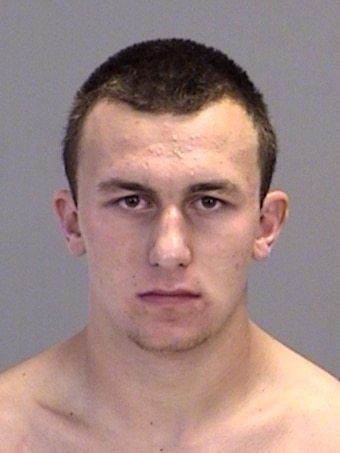
How We Talk When We Talk About Johnny Manziel (Ombudsmandry)


For those of you who may not know, Johnny Manziel, a redshirt freshman quarterback for Texas A&M won the Heisman Trophy last season (the first freshman to do so) and guided the Aggies to an 11-2 record and a no. 5 finish in the AP Poll.

I'm reminded of this nearly every day because Manziel's exploits, both on the field and off, are meticulously documented through social and traditional media. America can't get enough of the legend of Johnny Football. That's right, grown men are unabashedly and unironically calling a 20-year old kid "Johnny Football" (Johnny Fucking Football, if you're not into the whole brevity thing). 

Since winning the Heisman and beating Oklahoma in the Cotton Bowl. Manziel has been spotted sitting courtside at various sporting events, earned a new Mercedes, took in Mardi Gras in New Orleans, done his level best to avoid contact with actual Aggie fans, was declared the "King of Cabo" by TMZ and met rapper/former Degrassi hero Drake. (I bet he calls him Aubrey). 

Johnny Manziel is America's hero. He's the rootinest, tootenist quarterback since Broadway Joe. He's living the dream of every poor schlub with long dashed d-1 aspirations. He's got talent, fame and, apparently, unlimited access to basically everything. 

Think on that readers, dwell on that, dwell on the fact that Manziel basically exists as a youthful surrogate for your average football fan.

Now... imagine if Manziel was black. 

Did I just blow your mind? Did I just go Toure on your ass?

Ok, so don't actually imagine the Johnny Manziel is black - that's a weird and unproductive thought exercise. 

Instead imagine that, out of nowhere, a black freshman quarterback put on an electric season, won the Heisman trophy and then proceeded to party his ass off for the ensuing four months - popping dom in the club with his parents, driving an expensive car and trolling his own fanbase. 

There would be mass hysteria! It's pure, unadulterated gloryboyism! 

Imagine with me, if you will, if that same athlete had been arrested only a few weeks prior to the start of the season for scrapping in a bar district and using a fake ID? (It should be noted that Manziel missed no playing time for this, and his punishment was handled internally).

Why he'd not only be a glory boy, but also a thug! He'd be no good to anyone. Awarding him the Heisman trophy would be a disgrace to the good name of the Downtown Athletic club. (Gregg Easterbrook would personally bar the doors to the event).

"But Kyle," you say, "we're living in post-accidental racist America. Surely you're trying to make mountains out of molehills?"

I counter, "Bullshit." 

There was another electric young quarterback who recently came out of nowhere to destroy SEC offensive records and win a Heisman Trophy. Like Johnny Manziel, the fans have also given him a charming nickname. 

Perhaps you're familiar with $cam Newton? 

Newton's no innocent (he was kicked out of Florida for stealing a laptop and someone in has family probably received a hefty sum for delivering him to Auburn), but he certainly doesn't deserve the amount of vitriol that is routinely leveled at him via sports radio and online forums. 

You may argue that Cam is actually castigated because he allegedly took money to play at Auburn and thus violated the romanticized notion that all college players are just dedicated "student-athletes" playing to lift the spirits of their fellow young scholars. If intimations of untoward behavior are all it takes to stain an athlete forever, I point toward Manziel's sudden influx of discretionary cash and priority access to basketball games. After I'm done pointing at that, I'll point toward A&M's own illustrious history.

(Ahem...)

But, if you still think Cam is a false equivalency, turn instead to former Oklahoma State star (and apparent nightclub enthusiast) Dez Bryant. Prior to being drafted into the NFL, Bryant was asked by Miami Dolphins' GM Jeff Ireland if his mother was a prostitute. That question is not only utterly inappropriate, but also oh wow yeah kind of racist. 

Even more egregious than Ireland's questioning was the Palm Beach Post's Ben Volin claiming that Bryant's recent behavior justifies what Ireland asked. Go home America - clearly racism is solved. 

"Ok," you concede, "maybe there is a little bit of double standard. Maybe black athletes are more highly scrutinized and more harshly judged than white ones, but why single out Johnny Football?" 

Let's delve back into that arrest report from earlier:

Seaton says an officer on bike patrol intervened to break up a fight between Manziel and McKinney. McKinney told the officer that Brant, Manziel's friend, called him a racial slur and he approached 
Brant. Seaton says Manziel then shoved McKinney and the two exchanged punches.

The arrest that kicked off the legend of Johnny Football all started because Manziel felt that he was honor-bound to defend his friend's right to degrade a passing pedestrian with a slur. 

Of course, that's all dependent on whether or not the police report is true. It's possible that McKinney embellished the story, or that Manziel didn't hear Brant say what he said.

Regardless, it's odd to me that no one in the national media has asked about this particular part of the incident, if only to get a good soundbite of Manziel admonishing such behavior.

Instead, it's swept under the rug, it's not something that's fun to talk about.

Just like it's not fun to talk about the incredible chasm between the way in which Manziel is received and the way previous, black, college superstars have been received. 

It's a difficult thing to write about. First, one must prove that there is a clear difference in public perception - which is pretty hard to do - and even then, the type of person who doesn't want to think about these kind of things will claim that there is no difference and that the writer is merely "race-baiting" (the preferred phrase of anyone avoiding introspection for the past forty years).

Beyond that, what purpose does such an observation actually serve? It tells us that football fans may be racist (however inadvertently) and may have a selective bias about whether or not an athlete's behavior offends him or her, but that's not news. 

What does the legend of Johnny Football tell us about America?

I think the most basic (and, again, not unexplored answer) is that white behavior is still very much held up as normative. When a black athlete indulges in the perks that come with talent it's seen as aberrant and detrimental to "The Game" - the sport-above-sport from which all punditry flows. 

When a white athlete partakes in similar indulgences, he is praised for having fun out there and doing what anyone would do in his situation. 

Of course, my conclusions about all of this could be wrong, but I'm dead certain that the way we're ignoring this double standard is a black eye on sports journalism as a whole. 

Wednesday, March 28, 2012

Defending Stephanie Eisner (A Losing Proposition)


This cartoon, by Stephanie Eisner, recently appeared in my university's venerable student publication, The Daily Texan.

This has, justifiably, caused quite a stir. The whole cartoon seems loathsome, mean spirited, and ignorant.

What this entry pre-supposes is, maybe it isn't?

To preface this, I really wish that this cartoon had not been published. It embarrasses Texas, the university, the Texan, and, by association, myself.

To further preface this, I think the Trayvon Martin story is one of the most heartbreaking and despicable that I have ever heard. I think Zimmerman should be arrested and tried for murder or manslaughter. (I would say that I hope he is sentenced, but, as an American, I'm obliged to give him the benefit of the doubt).

Lastly, and I realize that I'm tackling a sensitive topic, I would like to emphasize that The Wire is my favorite television program, and therefore it is physically impossible for me to be a racist. Therefore everything I say comes from a place of thoughtful introspection, not hate.

(I realize this is impossible to prove, and the idea of being "fair and balanced" is often used as a smokescreen for racist opinion. I hope that's not what I'm doing here, but who knows what evil lurks in the hearts of men?)

It's important to keep in mind that this cartoon is addressing the media coverage of the Trayvon Martin case (or at least how Eisner perceives the coverage), not the details of the case itself.

I think a large part of the public outcry about this cartoon emerges from the public being unable to separate the two. One can't blame them, the case is so emotionally shattering that the emotional charge is going to carry into every aspect of the Trayvon Martin discourse. But, in order to be fair to Ms. Eisner and to fulfill our role as responsible media consumers, one must attempt to distance oneself from this emotional reaction.

The outrage lightning rod for this cartoon is Eisner's use of the word "colored." I refuse to believe that a college educated person is unaware of the connotations that this word carries, so I'm going to give Eisner the benefit of the doubt and assume that she intentionally used such a charged word in order to communicate a larger point.

Why did she choose this word? Why not "African-American" or "black?" If all that Eisner wanted to communicate was that the media tends to latch on to stories of racial violence and frame them in a very black and white (literally and figuratively) way, then both of those words would have sufficed. So there must be something deliberate that she was trying to communicate with the use of "colored."

The interpretation that I'm going with (which may not be Eisner's) is that she chose "colored" precisely for its patronizing roots. The word recalls white imperialism and the "white man's burden." I think that Eisner is trying to communicate that the discourse around Trayvon is in many ways condescending. Framing the story exclusively as white on black crime simplifies many complex issues into one easy to follow narrative. This simplification does no one any favors, with the possible exception of White people, who are content to use the incident as a way of "empathizing" with black America, thereby absolving themselves from engaging with racial issues in any real way.

The use of the word "handsome" is perplexing. "Sweet" and "innocent" make sense, but handsome seems to come out of nowhere. My interaction with the Trayvon Martin case has come largely by way of Twitter and message boards, so I don't know whether or not the media is actually commenting on Trayvon's appearance. If this has any basis in fact, then maybe this is another example of Eisner trying to point out the way that people are trying to use this incident to rebuff imagined accusations of racism. Western art and pop culture has often portrayed black men as grotesque and animalistic. Perhaps Eisner is using the word "handsome" as a way of saying that the media is intentionally distancing themselves from this racist past by using language that would normally have no place in a news report. While not as explicitly patronizing as the word "colored," any media focus on Trayvon's appearance would be pandering, at best.

Unfortunately for Eisner, none of this really qualifies as yellow journalism. This isn't an example of the media being deliberately inflammatory. In this instance, the media is merely a reflection of the American cultural zeitgeist.

I think that Eisner was attempting to express frustration with the way our culture deals with racial issues, but misdirected her ire.

Eisner should not be directing her anger at the media, instead, she should be confronting American society itself.

Rather than use the Trayvon Martin tragedy as an excuse to show how non-racist we all are, we should instead use it to explore some of the ugly problems in American society that it exposes.

In many ways, I'm uncomfortable writing this post. I feel like any incident can serve as an opportunity to explore some larger issues, but for this case in particular, it almost seems impertinent. The whole ordeal is so pointless and tragic, it's as if any attempt to analyze the situation trivializes it. Perhaps I am no better than Eisner's imaginary media.

Maybe that's ok. Maybe it's ok to be utterly defeated by a situation, but at the same time, try to learn from it. It's such a powerful story.

Why did this incident happen in the first place?

Why did Zimmerman react the way he did to a young black man in his neighborhood?

Why did Zimmerman feel the need to carry a firearm and patrol his neighborhood?

Why did Zimmerman find it necessary to shoot Martin, if Martin was clearly unarmed?

Why did Martin and Zimmerman get into a physical altercation?

Why do legal mechanisms exist that prevent Zimmerman from being arrested until all the facts come out?

How did our society get to the point where wearing a hoodie is equivalent to looking like a criminal?

Why is merely "looking like a criminal" an excuse to be harassed?

Why was the hispanic Zimmerman described as white?

Why have people used this incident as an excuse to further their own biases?

Over the past few weeks I've seen totally shameless things online.

Things like this.


Seriously, you guys. What is this? How do people like this still exist in the United States?

In addition to open racism, like the photo above, there are the people who are quick to dismiss any suggestion that there was a racial element to the incident by using the old stand-by "race baiting."

Let's just banish the phrase "race baiting" from public discourse. It's the bastion of the person who is too cowardly to admit that race is a huge issue in this country.

On the other side, there are the people I mentioned earlier. Those that are taking advantage of this tragedy in order to show how enlightened they are -- demonizing Zimmerman and idealizing Martin without taking the time to think about the larger issues that this incident exposes.

Rather using Travon Martin as an excuse to further your own biases and agendas, or to expose the supposed biases and agendas of your ideological enemies. I'd encourage everyone to reflect on this incident for what it is -- a totally avoidable tragedy that was made possible by a mad cocktail of idiocy and willful ignorance.

The unexamined society is not going to get better. American attitudes about race and violence will never improve if we keep pretending that everything is going to be fine, and that all starts with the individual. We can't help being blind to nefarious forces in society if we are blind to them within ourselves.

Maybe all of this is what Eisner was trying to communicate with her cartoon. Or maybe she's just an idiot.

"I feel the news should be unbiased. And in the retelling of this particular event, I felt that that was not the case. My story compared this situation to yellow journalism in the past, where aspects of news stories were blown out of proportion with the intention of selling papers and enticing emotions." -- Eisner in an interview with the Daily Texan.